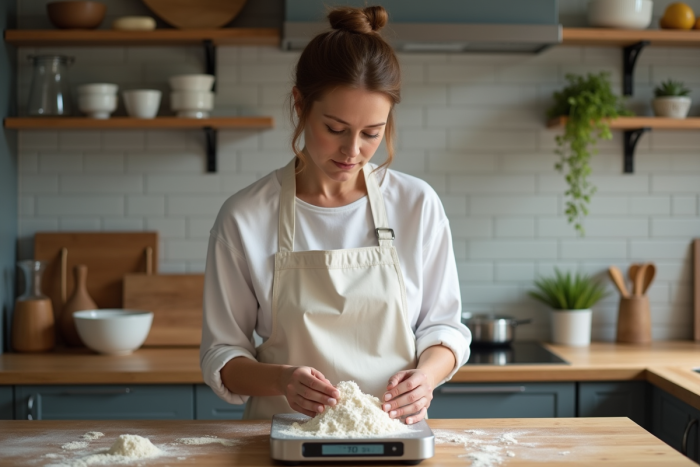
Cooking and Precision: How to Adjust Quantities According to Units
A French tablespoon does not contain the same amount of liquid as an American tablespoon. For 100 grams of flour, some conversion tables indicate 160 milliliters, while others indicate 185. The correspondence between weight and volume varies according to the density of each ingredient, making equivalences sometimes misleading.
The use of different units in books and on packaging complicates recipe preparation. The margins of error increase as measuring instruments or methods differ from one country to another.
Why unit conversions are essential for successfully executing all your recipes
In cooking, precision is not just the domain of laboratories: it is present at every stage, from weighing flour to measuring a splash of vinegar. Altering the quantity of an ingredient, even slightly, is enough to change the texture of a dough or the harmony of a dish. To adjust a recipe to the size of the table, avoid waste, or achieve the right consistency, converting units becomes a necessary step.
Each country has its benchmarks: the American recipe works in cups, the French one in grams, while elsewhere, milliliters reign supreme. Flipping through an international cookbook often means juggling disparate measurements: there’s no room for chance if you want the flavors to hold up. Even a simple spice measurement can throw a dish off balance without a minimum of rigor.
Conversion is not just a matter of numbers: it conditions the structure of the recipe, the balance in the mouth, the success of a dessert, or the lightness of a dough. To navigate this, it’s better to equip yourself with reliable tools or consult resources like 400 ml in g, which detail the equivalences for each ingredient. By relying on these benchmarks, you avoid dosage discrepancies, gain accuracy, and ensure a perfect texture, whether you are making homemade pizza or a smooth sauce.
Here are some concrete reasons to integrate unit conversion into your cooking habits:
- Adjust quantities for each guest: conversion allows for tailored portions without sacrificing the balance of flavors.
- Successfully execute international recipes: translating measurements is the key to faithfully reproducing a dish from elsewhere.
- Master ingredient dosing: consistency in proportions guarantees professional-quality results, batch after batch.

Practical charts and tips for easily adjusting quantities in the kitchen
In cooking, every unit counts. Between grams, milliliters, centiliters, and liters, clear benchmarks are needed to avoid getting lost. Whether you are a novice or an experienced cook, the reliable tools are the same: scale, measuring cup, measuring spoons, not to mention conversion charts that simplify life and avoid approximations. A simple example: 250 ml of milk is enough for a fluffy pancake batter, which is 25 cl; a successful béchamel requires 100 ml of milk, or 10 cl. Knowing these equivalences often makes all the difference.
Here are some essential correspondences to keep handy:
- 1 cl = 10 ml
- 1 l = 1,000 ml
- 1 kg = 1,000 g
- 1 tablespoon = 15 ml
- 1 teaspoon = 5 ml
- 1 cup = 240 ml
A well-designed conversion chart quickly becomes indispensable. It allows you to switch from one unit to another without fumbling, avoids dosage errors, and helps you approach recipes from elsewhere with confidence. For dry ingredients, the scale remains the reference. For liquids, the measuring cup or measuring spoon ensures welcome precision. Graduated bowls and specialized mobile apps make the task even easier, from the work surface to the smartphone screen.
Faced with the diversity of units, there’s no need to leave it to chance: it’s better to organize your conversions, rely on reliable benchmarks, and use the right tools. This guarantees consistent textures, saves ingredients, and serves portions suitable for every occasion. Today, cooking is structured around these tools: technical sheets, equivalence tables, digital applications. Mastering conversions is no longer reserved for professionals: it has entered every kitchen, for dishes that are accurate, controlled, and true to the spirit of the original recipe. This is how to turn every attempt into success, and every dish into a promise kept.