The Meuse valley at the heart of the Pays de Stenay and Val Dunois
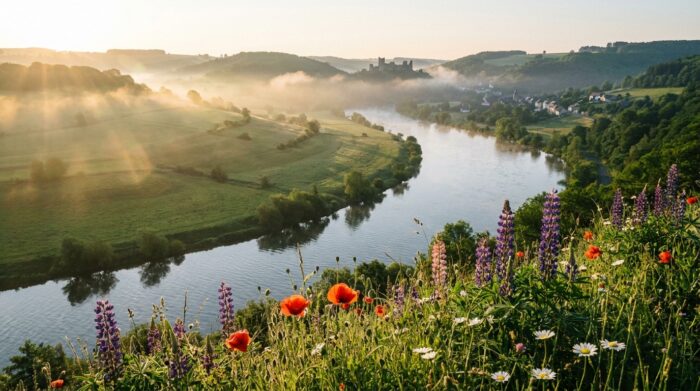
Around Stenay and Dun-sur-Meuse, villages united as a community of municipalities since 2017.
41
municipalities
Along the Meuse
The history, heritage and trails of each village, from the banks of the Meuse to the hillsides above it.
From Ancravilla to Inor
The editorial team
Aincreville, recorded in the 14th century as Ancravilla, takes its name from a man with a Germanic name, Angeranus, and from the Latin villa, the estate.
Baâlon goes back further: excavations there have uncovered a Gallo-Roman house with a hypocaust and a street lined with four buildings.
The whole area can be read from the hillside of Inor: at 326 m, the view sweeps over the Meuse valley, towards the Argonne, the Côtes de Meuse and the Ardennes.
Places to know
From Doulcon to Dun-sur-Meuse, by way of Stenay.
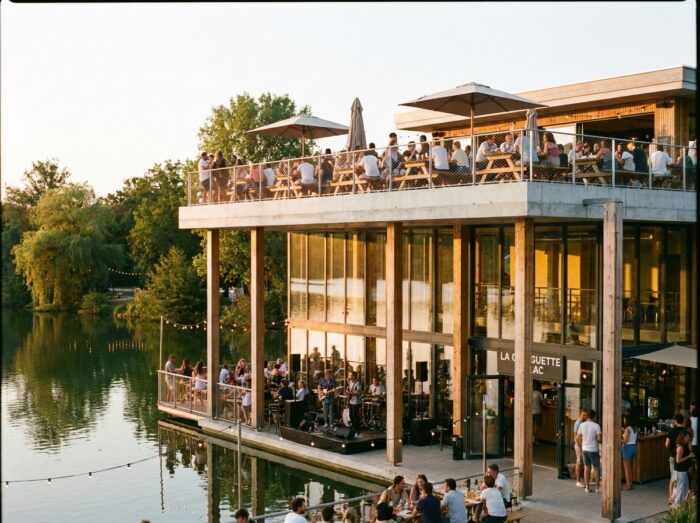
Guinguette and dependencies of the Green Lake
In Doulcon, the guinguette on the Lac Vert beach, built in 1938-1939 along the principles of the Modern Movement, has held the Architecture contemporaine remarquable label since 2015.
Walking circuit in Stenay
Starting from the harbour master’s office, the “In the heart of the city” circuit is about 2.4 km long; it is waymarked on the ground with the Stenay coat of arms.
Circuit of the fortress in Dun-sur-Meuse
The castle built in the 11th century above the Meuse was dismantled on the orders of Louis XIII in 1642.
Details to notice in the heritage and nature
A crypt, funerary crosses, a bat mine, a fortified gate and a chapel lavabo.
Heritage
Church of Notre-Dame, Mont-devant-Sassey
The church of Notre-Dame in Mont-devant-Sassey, with its portal and crypt, has been listed as a historic monument since 1875.
Where to look? In Mont-devant-Sassey.
Autréville-Saint-Lambert
Funeral crosses in the cemetery
The cemetery preserves twelve funerary monuments from the 16th to the 18th centuries, ten crosses and two plaques brought from the former village of Soupy, listed in 1994.
Where to look? In Autréville-Saint-Lambert.
Mine and biodiversity
Refuge for bats
A former mine in the village, turned into a bat refuge, is one of the curiosities along the Forgettes trail.
Where to look? In Halles-sous-les-Côtes.
Fortified gate
The Milly gate
The Milly gate, dating from 1402, was the eastern exit of the fortified town.
Where to look? In Dun-sur-Meuse.
Rural church
Church and ancient objects in Beauclair
The Saint-André church in Beauclair was built in 1835 and contains an 18th-century statue of its patron saint as well as a lavabo thought to come from the former chapel of the castle.
Where to look? In Beauclair.
Latest articles
Recent blog posts.
-
Small Budget, Big Style: Create a Chic Home Without Breaking the Bank
The second-hand and reuse market has changed the way people furnish their homes. With donation platforms, online flea markets and low-emission paints, there are now more ways to create a characterful space without spending more than a few hundred euros. The real challenge is no longer finding a…
-
How to Easily View a Solar Energy Specialist’s Sitemap?
A sitemap is a file or page that lists all the accessible URLs on a website. For a solar panel installer’s website, it includes service pages, completed projects, service areas, and informational content. Knowing where to find it makes it easier to navigate without relying on the…
-
How to Find Inspiration for a Home That Reflects Your Style
Creating an interior that reflects your personality starts with assessing the gap between what appeals to you visually and what works in your actual space. Available floor space, natural light and housing regulations all shape your options long before you choose a color or a piece of furniture. This article compares the main sources of interior design inspiration…
-
What Will Change for You with the New Digitalized Action Logement Offers in 2026
For several months, Action Logement has been accelerating the digitization of its services. For employees looking for social housing, assistance with the deposit…
-
Essential Fashion Trends to Elevate Your Style with Elegant Accessories
An accessory refers to any item worn in addition to an outfit to alter its visual effect: jewelry, bag, belt, scarf, hat, or shoes. In…
-
All the car trends and good deals to discover online this year
When searching for a car online, the first instinct is often to compare prices on three or four different platforms, without really…






Did you know?
From the vines of Inor to the deputy of Baâlon.
Inor Meuse
Around 1830, Inor had 78 ha of vines; phylloxera, followed by the First World War, almost wiped out its vineyards.
Autréville-Saint-Lambert Meuse
The fleurs-de-lis on the coat of arms recall the ambush laid for Louis XIV’s escort at the place called Trou de Soiry, in August 1657, after the capture of Montmédy.
Baâlon Meuse
Jean Chenet, born in Baâlon in 1764, was a deputy of Meuse in the Council of Five Hundred and in 1815 during the Hundred Days.