Complete guide: when and how to prune bush sage for a vibrant garden
Sage (genus Salvia) is a bushy perennial from the Lamiaceae family. Its semi-woody stems bear fuzzy leaves and floral spikes that renew from spring until the first frosts. Pruning directly affects the density of the growth and the duration of flowering. Poorly timed or overly harsh pruning can, on the contrary, weaken the plant, delay flowering, or worsen water stress.
Young wood vs. old wood: understanding growth before cutting
Sage flowers on the wood of the year. The buds that will produce floral spikes form on the most recent shoots, not on the old, woody branches. This characteristic dictates the entire logic of pruning.
On an older plant, the base gradually becomes bare. The lower stems turn gray, brittle, and no longer produce leaves. Pruning only the tips does not solve anything: flowering moves up the bush while the center remains empty.
To know when and how to prune sage, the distinction between young wood and old wood is the starting point. A cut that goes down to the green wood (the still flexible part, with visible buds) stimulates the growth of new shoots. A cut that touches the dead wood produces nothing.
Winter exit pruning: the structuring gesture for sage
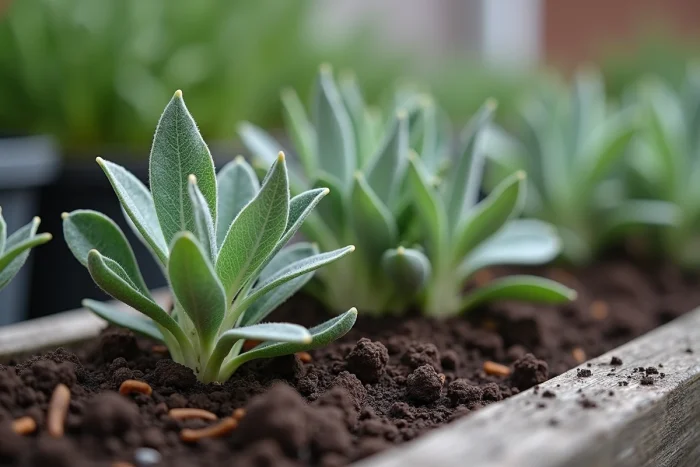
The most crucial intervention occurs at the end of winter, when the last frosts have passed but before the vegetation starts to grow again. Depending on the regions, this falls between late February and mid-April.
Why this specific moment
Pruning too early exposes the cuts to frost. Pruning too late deprives the plant of weeks of growth and delays the first wave of flowers. The ideal window is just before the vegetative restart, when the first buds swell at the base of the stems.
Cutting height according to the age of the plant
Not all sage plants are pruned the same way. The age and vigor of the plant change the approach.
- For a young plant (less than two or three years), a moderate formative pruning is sufficient: shorten the stems by about a third to encourage branching without exhausting the plant.
- For a mature and well-established plant, cutting the branches above the second or third bud from the base allows for the renewal of the framework while maintaining an acceptable volume from spring.
- For an older plant, bare at the base, a vigorous rejuvenation pruning is necessary: cut short, a few centimeters from the ground, ensuring at least one green bud is left per stem. The bush will take a few more weeks to reform its shape but will start anew on fresh, vigorous wood.
In-season pruning: light cuts to prolong flowering
The end-of-winter pruning is not the only useful intervention. During the beautiful season, light repeated cuts after each wave of flowering stimulate the appearance of new spikes without weakening the plant.
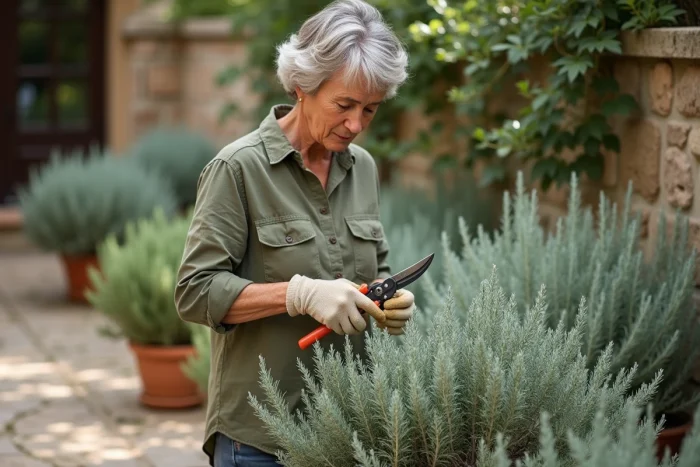
The action consists of removing the faded flower spikes by cutting just above the first pair of well-developed leaves. No need for heavy-duty pruners: a clean, sharp bypass pruner does the job.
This logic of small maintenance cuts works better than a single severe intervention in the middle of summer. The plant retains enough foliage to photosynthesize properly, and the flowering resumes more quickly. In practice, two to three passes between June and September are sufficient to maintain a nearly continuous flowering until the first frosts.

Common pruning mistakes and climate stress
The first mistake is pruning in the fall. The new shoots triggered by the cut will not have time to harden before the cold. They will freeze, and the plant will lose energy for nothing.
The second is cutting during a heatwave. Water stress combined with the loss of leaf surface can cause partial drying out or even the death of the plant in well-draining soils. It’s better to wait for a sequence of moderate temperatures or to intervene early in the morning.
Tools and cutting hygiene
Sage plants are rarely affected by serious diseases, but a dirty tool can transmit fungi from one shrub to another. A quick cleaning of the blades with alcohol between each plant reduces this risk. In terms of tools, three tools cover all needs:
- A bypass pruner for this year’s shoots and faded flower spikes.
- A lopper (or branch cutter) for woody branches over one centimeter in diameter on older plants.
- A hedge trimmer for quickly leveling a mass of identical sages planted along the edge.
Sharp blades produce a clean cut that heals quickly. A crushed cut leaves fibers exposed to moisture and pathogens.
Adapting pruning to regional climate
In a mild oceanic climate, sage can remain semi-evergreen. The end-of-winter pruning is then limited to cleaning damaged parts and slight shortening. The vegetation resumes quickly, sometimes as early as February.
In a continental or mountainous climate, frost can drop below minus ten degrees. The winter exit pruning is delayed to late March or even early April. Leaving the dry foliage in place during winter offers natural protection to the base buds. Removing it too early means eliminating this insulating layer at the worst possible time.
In a Mediterranean climate, summer heat is the limiting factor. Pruning after the first wave of spring flowering, then mulching the base, helps limit evaporation and restart autumn flowering when temperatures drop again in September.
Sage is quite tolerant, provided that each cut falls within the right window. A clean pruner, careful observation of the wood, and a schedule adjusted to the local climate are enough to keep a dense, flowering, and healthy bush for many years.