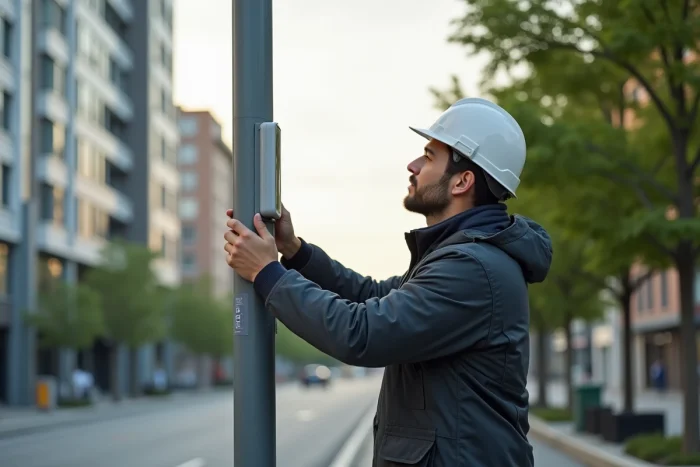
How the Fly Light solution is revolutionizing smart and cost-effective public lighting
40%: a fraction that, when applied to a municipality’s energy budget, leaves little room for lightness. Urban lighting, often underestimated, consumes considerable resources. Faced with aging infrastructure, it becomes urgent to rethink the light that illuminates our streets. The promises of connected systems remain, for many, a dead letter; the majority of the French network still operates with outdated equipment, unable to adjust to actual demand. However, local authorities are seeking the balance point: saving without compromising safety, innovating without complicating management.
Fly Light does not enter the scene timidly: innovation asserts itself unequivocally. Built around adaptive algorithms and an evolving infrastructure, this system shakes up habits. The initial feedback is unequivocal: energy expenses in free fall, reduced maintenance, and a network management that finally gains agility.
Why public lighting must evolve in the face of energy and urban challenges
Street lighting does not merely secure public space: it alone weighs heavier than any other item on a city’s electricity bill. Energy price increases are accumulating; the climate crisis no longer tolerates half-measures. Yet, nearly half of the light points in France are over a quarter of a century old. The era of “always brighter” is coming to an end. It’s time for sobriety and technology.
In this context, LED has replaced old sodium or mercury lamps. Its strength? It adapts: the intensity varies according to traffic, natural light, or hourly needs. This change is accompanied by a new generation of sensors capable of detecting presence or assessing ambient light. The result: tight management, point by point, where yesterday the network operated in “all or nothing” mode.
Telemanagement and telemaintenance solutions are game changers: remote control, real-time monitoring, instant diagnostics. Technical teams no longer move blindly; each intervention is targeted, each failure anticipated. The result is lower expenses and public services that gain reliability.
In this transformation, Yoolight’s Fly Light solution stands out. Thanks to the interoperability offered by the Zhaga standard and the D4i driver, each luminaire becomes scalable and repairable. The network is no longer limited to lighting: IoT and Li-Fi are invited to collect environmental data, monitor via video, or enable electric vehicle charging. This opening of uses propels cities onto the path of urban intelligence, far from simple automatic lighting.
Local authorities juggle multiple constraints: preserving safety, reducing costs, decreasing carbon footprint, all without degrading the service provided. Intelligent public lighting, driven by Fly Light, appears as a concrete response. Here, technical progress rhymes with local adaptation and budget control.
Fly Light: what innovations for intelligent and economical lighting?
Fly Light stands out with a resolutely management-focused approach and simplicity of evolution. At the heart of the system, the Zhaga standard and the D4i driver redefine maintenance. Streetlights are no longer fixed: they can be repaired, modernized, and evolve according to the municipality’s needs, thus avoiding systematic renewal.
Interoperability makes the difference. Adding a motion sensor, integrating a telemanagement module, or a Li-Fi solution? No need to rethink everything: each new service simply integrates into the existing setup. Telemanagement allows for programming light intensity remotely, adapting lighting schedules, while telemaintenance detects even the slightest anomalies in real-time. Interventions are no longer triggered in emergencies but based on predictive analysis, significantly reducing maintenance costs.
Another advancement is communication via Li-Fi: light carries information faster and more securely than traditional Wi-Fi. This technology opens up unprecedented perspectives for urban services while placing data control in the hands of local authorities.
Here are the standout advantages of Fly Light for public lighting managers:
- Instantly controllable LED lighting to adapt to every situation
- Connected modules for air monitoring, video, or electric charging
- Energy consumption management by light point for precise expense control
By combining adaptation, energy performance, and tailored services, Fly Light helps shape the face of a connected, sober city capable of meeting contemporary challenges.

Concrete results for local authorities: savings, performance, and sustainability
The figures from the first implementations of solutions like Fly Light are unequivocal: the transition is accompanied by a significant reduction in expenses and a leap in efficiency. In Bordeaux, public lighting now consumes 70% less electricity than before modernization. In Toulouse, the decrease reaches 64%. These results stem from a combination of intelligent management, which modulates intensity based on traffic and time, and telemanagement that allows action on each light point remotely.
Maintenance is also evolving: remote monitoring immediately identifies any malfunction. Teams intervene before the problem becomes critical, reducing emergencies and extending the lifespan of equipment. For public finances, the benefit is measured in reduced operating costs and better resource allocation. The phenomenon extends beyond our borders: Los Angeles, Canberra, Jaipur, among others, report spectacular gains, sometimes up to 72% in energy savings.
The benefits of intelligent public lighting translate into:
- Reduction of carbon footprint thanks to decreased electricity consumption
- Enhanced urban safety through continuous light adaptation
- Deployment of new services: environmental monitoring, data transmitted via Li-Fi, charging stations for electric vehicles
The modernization of public lighting is no longer just a technical adjustment. It embodies a societal choice, where technological innovation aligns with environmental responsibility. The cities that adopt it move towards carbon neutrality, never losing sight of the quality of life and safety of their inhabitants. Light now illuminates not only the pavement but also the path to a more enlightened, agile, and resource-respecting urban future.